Most owners don’t notice arthritis arriving. They notice it after it’s already settled in, usually as a horse that used to trot out willingly and now needs a few strides to loosen up, or a paddock companion who’s started pinning ears when the girth goes on. By the time the signs are obvious, the joint has usually been under strain for a while. That’s the frustrating part of early degenerative joint disease in horses: it’s quiet, it’s easy to explain away, and it rewards owners who pay close attention rather than those who wait for a limp.
The Stiffness That Disappears Too Quickly
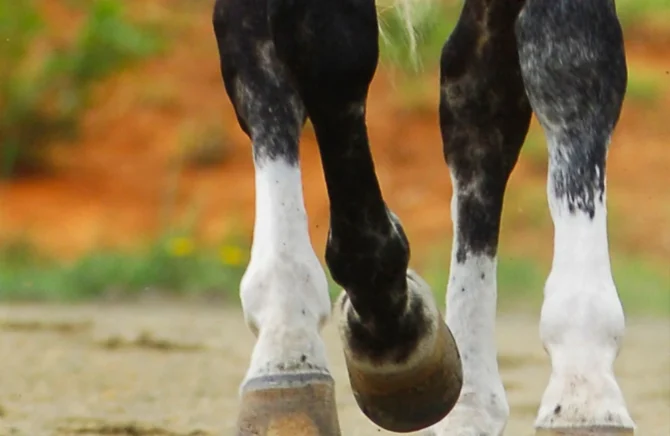
Classic early-stage arthritis shows up as stiffness after rest that fades within the first few minutes of movement. A horse might come out of the stable looking short and a bit wooden through the hindquarters, then seem completely normal ten minutes later. Owners often dismiss this because the horse “warms out of it,” but warming out of stiffness is itself a sign, not a reassurance. A joint that needs several minutes to loosen up each morning is telling you something about how it’s coping overnight, when movement stops and inflammation has time to settle.
Cold, damp mornings tend to make this more obvious, which is why many Australian owners first notice it in the change of seasons rather than gradually over months. If a horse who’s never needed a warm-up now seems to require one, that pattern is worth writing down and watching, not brushing off as a one-off.
Reluctance in Specific Movements
Mild joint pain often shows up as a preference rather than an obvious lameness. A horse might become reluctant to pick up one canter lead, swap unexpectedly, or feel slightly unlevel only in tight circles on a particular rein. These asymmetries can be subtle enough that a rider puts it down to fitness, laziness, or a saddle fit issue, and sometimes it genuinely is one of those things. But when the same one-sidedness turns up consistently over a few weeks, it starts pointing toward a joint that’s less comfortable under load, particularly in a hock, stifle, or fetlock.
Shortened stride length is a related clue. It doesn’t always look like limping so much as a horse covering less ground with the same effort, especially noticeable to a rider who knows the horse’s normal way of going. A farrier or physio who comments that the horse “isn’t quite tracking up” the way it used to is often flagging exactly this.
Heat, Filling, and the Things You Can Actually Feel
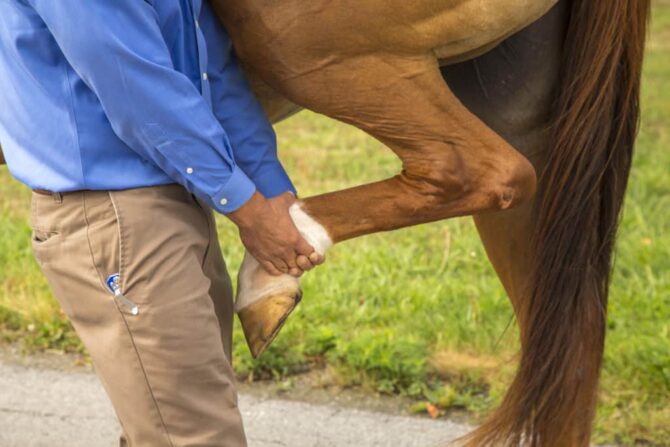
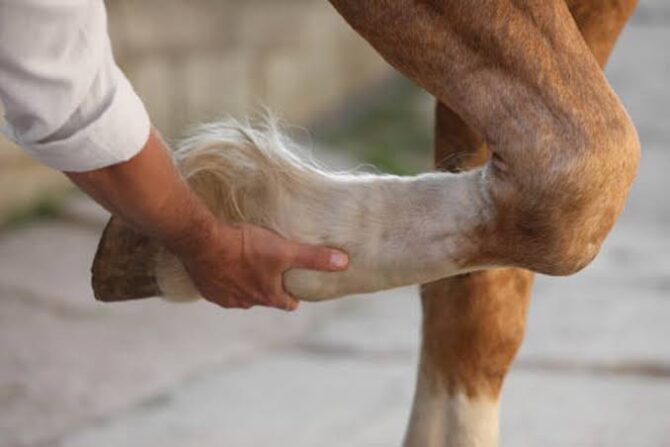
Not every case of mild arthritis produces visible swelling, but many do produce subtle changes worth running a hand over. Mild heat around a fetlock or hock after work, slight puffiness that wasn’t there the week before, or a joint that feels a touch fuller in the evening than in the morning are all worth noting. These findings alone don’t confirm arthritis, since plenty of things cause mild filling, but they’re useful data points to bring to a vet rather than something to self-diagnose from.
Behavioural Changes Under Saddle
Horses in mild joint discomfort often communicate through attitude before they communicate through obvious unsoundness. A previously willing horse might become reluctant to work on a particular surface, resist transitions it used to do easily, or become touchier about grooming and rugging around a specific area. Bucking on transition to canter, a flatter jump than usual, or general irritability under saddle can all be behavioural proxies for pain that hasn’t yet become visible as a limp. It’s easy to label these as training issues, and sometimes that’s exactly what they are, but persistent, out-of-character resistance deserves a second look rather than a firmer hand.
Why Catching It Early Actually Matters
Arthritis in horses is a progressive, degenerative process, and cartilage doesn’t regenerate the way soft tissue does. Once damage has advanced, options narrow considerably. Catching mild stiffness or subtle asymmetry early gives an owner and vet more room to move, whether that’s adjusting a training programme, addressing conformation-related loading, or starting a long-term joint support routine before compensatory strain spreads to other limbs. Horses are also remarkably good at masking discomfort, which means the visible signs are frequently the tail end of a process that’s been developing for some time.
Any of the signs above warrant a proper veterinary assessment, ideally including a lameness workup, before assuming anything or starting a management plan. Self-diagnosing from paddock observations alone risks missing something more serious or treating the wrong joint entirely.
Building a Long-Term Management Approach
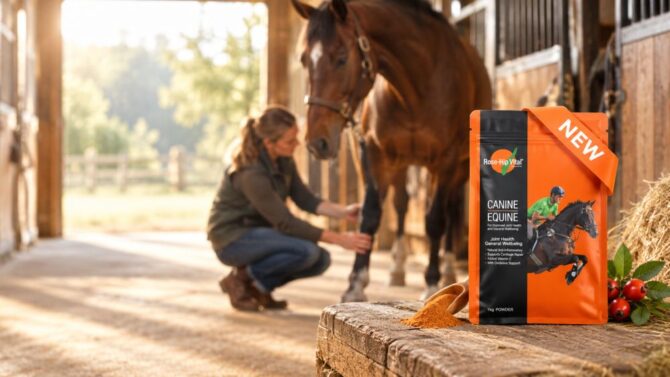
Once arthritis or early joint changes have been diagnosed, most vets recommend a combined approach: appropriate exercise, weight management, farriery review, and often a joint support supplement used consistently over time. This is the category Rose-Hip Vital sits in. Made from Rosa canina rosehips and containing the compound GOPO, it’s one of the more studied rosehip-based products on the market, with research including double-blind, placebo-controlled trials behind the ingredient. It isn’t positioned as a treatment for arthritis itself, but as daily support that some owners add alongside veterinary guidance, with most horses on the equine formulation showing changes within three to six weeks of consistent use.
The bigger lesson, though, has less to do with any single product and more to do with observation. Owners who know their horse’s normal way of going, who notice the extra minute of stiffness or the missed lead change, are the ones who catch joint problems while there’s still plenty that can be done about them. Rose-Hip Vital and products like it only become useful once that early noticing has already happened, and once a vet has confirmed what’s actually going on.